Pacing Yourself (and Your Team) Across a Long Production
Every production has a version of the same idea: that the real pressure is at the end. Crunch-culture treats the final stretch as the climax, the part where everyone digs deep and the work gets forged. But if you’ve been through more than a few long productions, you start to notice something else. The projects that actually break people rarely break them in the last six weeks. They break them slowly, starting around month four, through a thousand small decisions made without anyone noticing they were decisions at all.
Pacing yourself across a long production isn’t about rationing energy like it’s a finite resource you’re afraid to run out of (though that’s part of it). It’s about recognizing that animation work has a rhythm, a tempo, and most of the damage comes from not paying enough attention to that rhythm rather than from the work itself.
The previous AnimWorks blog post focused on how to survive tight deadlines. In this post, we’ll talk about tips on how to survive a long production.
Front-Loading the Work
Early in a production, everything feels urgent. The shots are new, the gameplay hasn’t been completely fleshed-out yet, and there’s a natural pull to throw everything at the first pass: extra polish, extra iterations, perhaps extra hours refining something that’s going to get notes anyway. The game is new, the design is new, the characters are new. It’s what happens when enthusiasm meets an open highway.
The problem is that a long production doesn’t always reward the animator who’s fastest out of the gate. It rewards the one who’s still making good decisions in month nine. Front-loading too much energy on early shots and motions often means those shots get more attention than they need, while later shots, arriving when the gas tank is more depleted, get less than they require. The quality curve ends up inverted from what the audience/player actually sees and feels, since the shots near the end of the schedule are often structurally more complex as well: bigger character moments, more interaction, more riding on getting it right. The basics got the huge amount of energy at the start (basic loco, attacks, defends, hit-reacts, etc.). But as the production develops, designers naturally find their footing and spread their wings, implementing more complicated mechanics.
One way to balance this is by treating your energy budget the way you’d treat a render budget (in long-form animation) or GPU budget (in games). You wouldn’t spend your entire budget on the first three shots of a sequence or apply crazy physics to a 12-tentacled enemy and hope the rest works out. Estimate roughly how much you have to give across the whole production, and be honest about which shots and motions actually need the extra passes versus which ones are fine at a solid level. Not every shot is a hero shot. Trying to make every shot a hero shot is one of the fastest routes to running out of gas before the finish line.
Blocking Fatigue vs. Polish Fatigue
Something that doesn’t get talked about enough is that different phases of animation work tap different kinds of energy, and burnout often comes from applying the wrong kind of energy to the wrong phase for too long.
Blocking work draws on decisiveness. You’re making a lot of calls quickly: key poses, timing, staging, and you need to trust your instincts enough to move on rather than second-guessing every choice. Polish work draws on patience. You’re in the graph editor for long stretches, refining tangents, cleaning up arcs, chasing down that one frame where the foot slides half a pixel. These require different mental focus.
Animators who burn out often describe the same thing: they stopped being able to switch between those modes. Blocking started feeling laborious because they were still in polish mode from the day before, second-guessing poses that didn’t need second-guessing yet. Or polish work started feeling scattered because they hadn’t fully shifted out of the loose, exploratory headspace of blocking.
If you can structure your days or weeks so that similar tasks cluster together, batching a run of blocking passes before switching into a batch of polish passes, you spend less energy on the mental gear-shifting itself. That’s not always possible given how productions assign work, but where you have any say in managing your own days, it might be an idea to experiment with. Blast through the blocking of as many shots as you can, then focus on polish for those shots. Smooth as butter.
The Plateau Is Not a Warning Sign
There’s a period in long productions that tends to get misread. Somewhere in the middle, the work stops feeling like it’s improving. Shots that used to feel like breakthroughs now feel routine. This plateau often gets interpreted as a sign that something’s wrong, that motivation is slipping, that maybe this isn’t the right project or the right role.
Usually it’s just what the middle of a long production feels like. The steep learning curve of the first act, the initial gameplay implementations, has flattened out because you’ve absorbed the character, how the game should feel, the pipeline, the director’s taste. What’s left is a long stretch of applying what you’ve learned, shot after shot, motion after motion, without the frequent dopamine hits of early discovery. That’s not decline. That’s competence settling in.
Recognizing this matters, because animators who mistake the plateau for a problem sometimes respond by pushing harder, trying to manufacture the excitement of the early days through brute force. That tends to accelerate burnout rather than prevent it. A better response is usually to lower the emotional stakes of the middle stretch. Treat it as the section where you’re supposed to feel steady rather than inspired, and save the harder pushes for the moments in the schedule that actually need them. The first period of the production was to figure things out, to row the boat hard. Right now, we’re coasting, we have wind in our sails, we know better where we should go, so it’s time to just steadily get things done.
Notes, Revisions, and the Compounding Weight of Feedback
Feedback loops are one of the more underrated sources of fatigue on long productions. A few rounds of notes on a shot is manageable. Six rounds of notes on the same shot, perhaps spread across three months, each one requiring you to remember context you’d already sort of forgotten, adds up to something heavier than the sum of its parts.
Part of pacing yourself is building small systems so that revisiting old shots are less stressful. Keeping brief notes on the reasoning behind key choices, saving intermediate versions with clear labels, documenting what a previous round of feedback actually asked for, all of this reduces the mental burden of returning to something you thought was finished. Without that kind of framework, every revision round with long periods between, means re-deriving your own decisions from scratch, which is exhausting in a way that’s easy to underestimate because it doesn’t look like real work from the outside. If the pipeline allows, it would be beneficial to have feedback rounds documented. In games, this could be in Jira. Generally, it could be in Slack. But documenting revisions is a great way to relieve stress down the line, and it also helps Production keep track of feedback.
If you’re a lead or director (whoever is giving feedback), it’s a good idea to remind yourself about the importance of a particular animation. Not all animations need to strike an ultimate level. Prioritize the amount of time and effort put into each shot. Build that time and energy to focus on the “big ones”, the shots/motions that will really “wow” your audience. If you’re a lead, and the director is going frame-by-frame on a background character, it might be good to ask them how important that character is to the overall project. Be gentle about this conversation, though, as you don’t want to come off as patronizing. The schedule is King, and time/staff budgets need to support it.
Recovery Isn’t the Opposite of Productivity
The instinct on a long production is to treat rest as time stolen from the work. But animation, more than a lot of creative disciplines, depends on a kind of internal calibration: knowing what a pose feels like when it’s right, catching a beat of timing that’s slightly off. That de-calibration happens with fatigue in ways that don’t always show itself in the moment. You don’t necessarily feel worse, you just start missing things you’d normally catch, and the work gets a little less sharp without anyone noticing right away.
Short, regular recovery, actual evenings off, actual full weekends, matter more than the occasional big break after a crunch period, because it keeps the gear calibrated throughout the production rather than letting them slip, trying to restore them all at once. There’s no universal formula for how much rest is enough. Different animators recover at different rates, and what someone needs also changes depending on the phase of production and what’s happening outside of work. But treating recovery as regular maintenance rather than as a reward is important to keep the batteries charged.
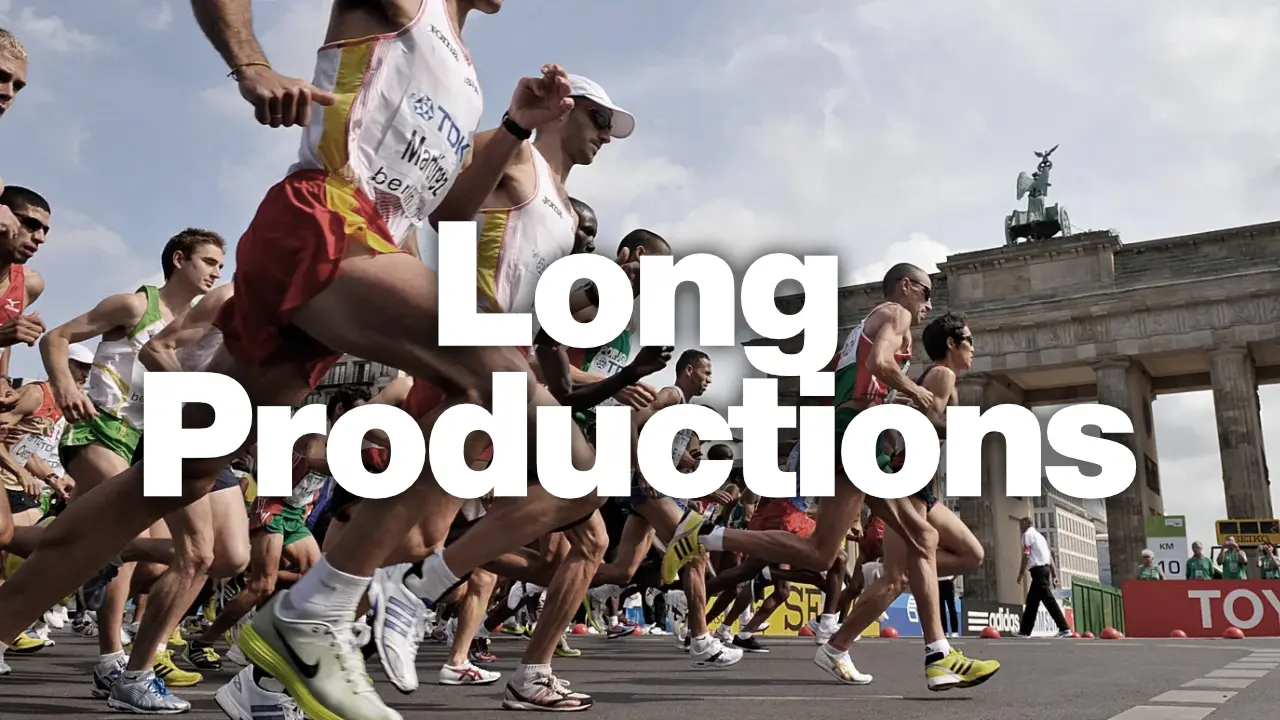
It’s a Marathon With Bursts Within
The old advice to pace it like a marathon, not a sprint, is true but incomplete. Because game development often uses the term “sprints”, we’ll call these short-term, high-focus crunch times as “bursts”.
Long productions do have bursts, deadlines that truly require a short-term push. It’s not about avoiding bursts completely. It’s about knowing which parts of the schedule actually call for them and reserving your capacity for those, rather than bursting by default because the whole production feels urgent all the time. Your lead/director/producer will probably announce that a burst is necessary, but they should also be realizing that bursts are apart from the norm, not the norm.
The ability to tell the difference between knowing where the real pressure points are versus where the pressure is just ambient anxiety, is something that gets sharper with each production. It doesn’t happen automatically. It comes from paying attention, after the fact, to where the energy actually went and whether it went to the right places. That kind of honest reflection is probably the most useful pacing tool there is, more useful than any specific schedule or ritual, because it’s the thing that lets you adjust the approach on the next long haul rather than repeating the same pattern.