












What brings a pose to life is what happens between the poses.
01Why this skill matters
For years, I believed the secret of good animation was mainly about solid key poses. Until the day I realized a killer pose could go completely unnoticed, while a simple movement could hook the viewer just through its rhythm.
Timing and spacing aren’t technical tweaks you slap on at the end to fix a shot. They are the heartbeat of your animation. In video games, they directly shape something huge: game feel.
Of course, strong poses are essential to make the action clear. But it’s the laws of physics that dictate the reality of a body: the weight it drags, the momentum it takes, the resistance it pushes back against. And it’s how you translate that inertia, how you land in a pose, hold it, and leave it, that tells the story.
A flat, linear rhythm kills intention, no matter how good your posing is. On the flip side, sculpting acceleration, choosing where movement stops dead and where it snaps, is pure storytelling inside time. That’s what gives a gesture its weight, intensity, and truth.
Timing and spacing aren’t technical tweaks you slap on at the end to fix a shot. They are the heartbeat of your animation.
02What the skill really is
- Timing answers when: it’s the temporal structure. It’s the number of frames you give an action to breathe, wind up, or hit. It’s the metronome.
- Spacing answers how: it’s how space is distributed from one frame to the next. It’s what translates inertia, weight, acceleration, or braking.
The classic trap is thinking they work in isolation. Spot-on timing with linear spacing will still feel mechanical. Sculpting your spacing, on the other hand, is deciding what the viewer feels between each key pose.
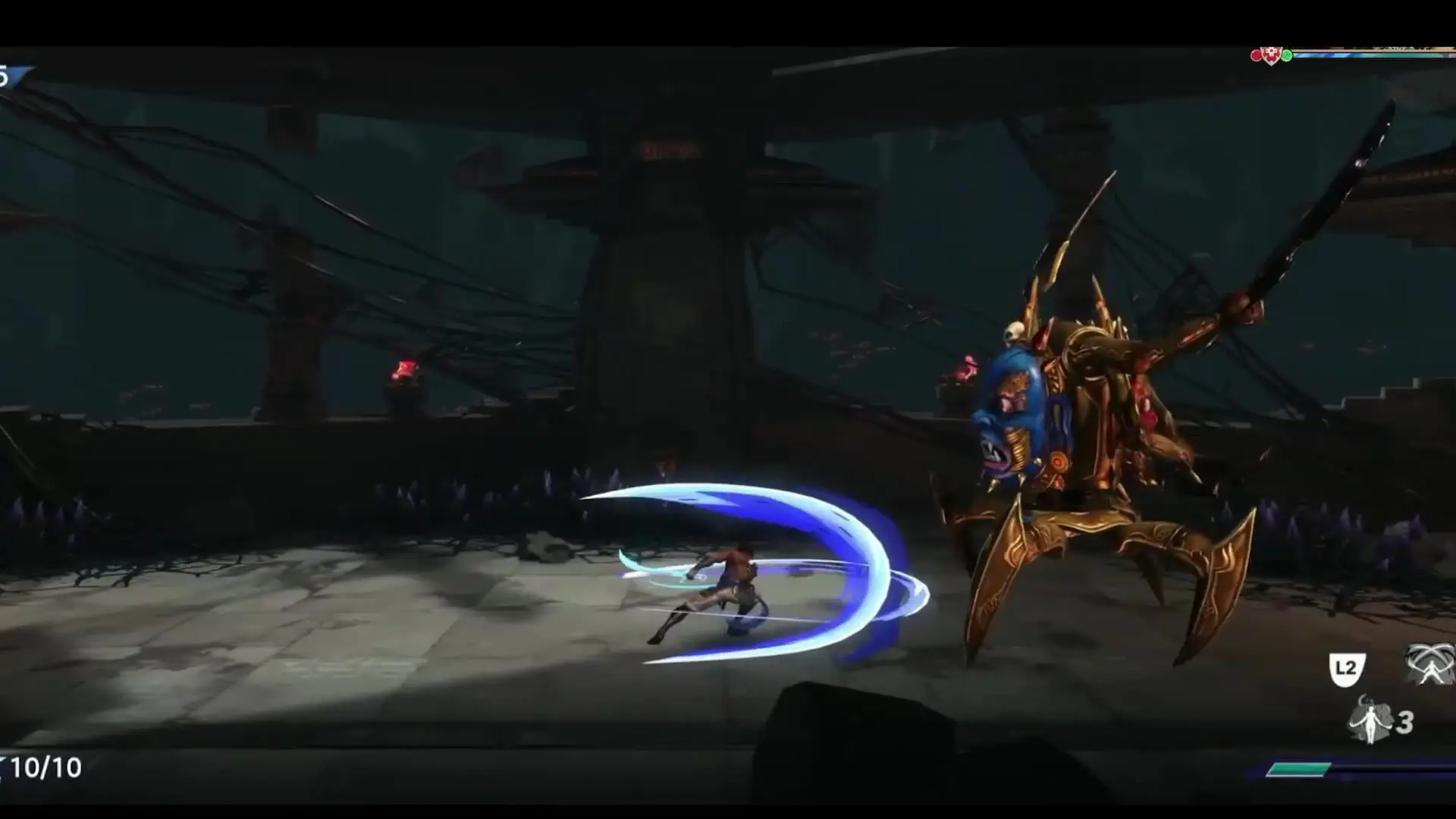
On Prince of Persia: The Lost Crown, attack timings were locked down to the frame so the player could react at the right moment. Total time was set very early by game design. So how do you stay creative and keep enemies from all feeling the same? That’s where spacing becomes your superpower.
Take a two-faced demi-boss who can attack from either side. If the player is on the left, it throws a left attack; if they stay on the left, it can chain into a second left attack. But if the player moves to the right, it chains straight into a right attack, and can even chain a second attack on that side. Unlike enemies with fixed combos, the whole mechanic flips. The timing of each strike is locked: the player needs to read which side it’s coming from and have time to slide. Yet with the exact same timing, spacing is what makes the difference between a blow that grazes and one that crushes: an anticipation held long enough to be readable, followed by a sudden snap right before impact, and a recovery that lets you clearly see where the hit landed.
When you’re working inside a tight box, the real question isn’t just when, it’s: what happens in the middle? The human eye is lazy. Give it an even, steady move and it tunes out. For an action to stick, you have to break that evenness: create a sharp snap when energy lets go, then offer a hold, a strong pose held just long enough to print on the retina before the body lets go.
Timing sets the frame, while spacing decides the physics and intention. For the exact same timing, how you spread movement through space completely changes the character’s personality and what the viewer feels. Whether you’re constrained by controller responsiveness in a game, edit pacing, or an actor’s action, the core problem is the same: you have limited time to make an intention clear and feel a weight. That’s what controlling the flow is: sculpting energy inside the frame instead of getting pushed around by the timeline.
03The components of timing & spacing
Forget the Graph Editor curves for a minute. When you’ve got a tight time budget, your spacing leans on three pillars that go hand in hand:
1. Contrast rather than symmetry
Real-world physics is often too polite for the screen. On Assassin’s Creed Syndicate, for instance, even with mocap shot by pro stunt performers, where the live-action rhythm can feel spot-on, the in-game result often feels sluggish if you leave it as-is. You have to rework timing and spacing, hold anticipations longer, tighten transitions, and punch up the hits to match video game codes, even when timings are way looser than on a frame-tight action game.
If you animate a move with dead-even symmetry, the action looks flat. Even spacing is the enemy of believable movement. What makes animation feel alive and punchy is alternation. Pushing contrast, daring to stretch a hold to build tension, then eating up the distance in just a few frames so the hit pops: that overall rhythm is what keeps the viewer from getting bored.
For a long time, I didn’t dare push contrast to the extreme out of fear of breaking the animation. I stayed in a comfort zone where everything was “fine,” just a bit lukewarm. What I’ve learned over time is that it’s right there in those extremes that animation becomes alive and punchy. A move with zero contrast has no punch, whereas an intentional distortion serving the rhythm holds attention.
Even spacing is the enemy of believable movement.
2. Commitment
Once you’ve got your overall rhythm, everything hinges on the exact spot where the action commits. A powerful move never starts at top speed, yet it shouldn’t drag on forever either. Here, the question isn’t spreading energy evenly across the whole arc, it’s managing the switch: compressing frames as tight as possible in the wind-up, then opening the spacing with a clean snap.
That sudden shift from compression to expansion is what gives immediate commitment. The viewer doesn’t just read a displacement; they feel the snap of the release. In animation, it’s easy to lean on software defaults to smooth out curves. But a default-interpolated move often comes out soft and purposeless. With experience, you realize that relying only on your reference or raw mocap isn’t enough: the whole trick is picking the exact spots to push against physics, where you lock and where you let fly in one burst so the move hits hard.
3. Suspension and release (exit inertia)
We pour tons of energy into the start of a move and the punch of impact, and way too often rush the exit. That’s a shame, because inertia is what stretches the story: it lets the body absorb, cushion, and redistribute the energy it just built.
Take a video game attack. A fast, nimble attack that needs to cancel or recover right away will have minimal recovery: inertia is cut short to favor responsiveness. By contrast, a heavy or charged attack carries so much released energy that the body physically has to absorb and damp it. That’s why recovery stretches out: physics demands it to let mass settle, and it also gives the player time to breathe, read the punishment, or react.
How a pose settles, how the body takes the deceleration, or how secondary masses keep drifting for a beat, that tiny moment of suspension before calming down, is what gives the character real weight. If you cut your action too abruptly without letting that inertia breathe, the movement loses believability and feels jerky. Spacing needs to stretch out through the deceleration to carry that follow-through, catching the leftover energy before letting it die out completely. That final breath is what locks the movement into the viewer’s mind.
04How pros think
- Timing gets negotiated. In production, the animator rarely calls the shots alone. Tech limits, story needs, or game design notes set the box. Not every project demands the same strictness: an action game like Prince of Persia calls for frame-accurate precision by nature, whereas more narrative or grounded titles like Beyond: Two Souls leave more breathing room on timings. Instead of fighting those limits, the move is to treat them like the rules of the game to back up the move’s intention. Out of constraint comes creativity.
- They think in critical frames. Focus goes on the moments that count (anticipation, point of no return, impact, recovery) while transitions can travel lighter. Shaving a frame or two off a fast pass buys time right where the eye actually reads the action.
- They block rhythm before curves. Intention has to work in blocking before touching curves. To make the action clear, that pass already has to tell the main story (timing, cadence, spacing) before polishing details. Smoothing interpolation over a blurry base usually creates more notes than it saves.
- They think in forces, not controllers. Instead of “where does this controller sit on frame 12?”, they ask “where is the force coming from, what resists it, where does the inertia go?”. Thinking that way stops you from treating limbs like isolated parts. Following the path of energy through the body brings overlap and chain reactions in naturally.
- They push extremes, then calm down. It’s what I keep telling my students: it’s easier and faster to dial back an over-pushed intention than to try to pump up a timid one. It lets you lay down clear contrasts and check the strength of the intention right away. Once the rhythm works, trimming amplitude or softening a gap is just polish.
- They judge in context. Timing isn’t judged in a vacuum. Camera framing, cutting, VFX, or chaining into other actions all shift how movement reads. Something that works solo can feel flat once dropped into the bigger picture. Checking rhythm in its real viewing context saves a lot of surprises.
It’s easier and faster to dial back an over-pushed intention than to try to pump up a timid one.
05How to observe it
- Watch spacing at two scales (whole body and details). Spacing reads on two levels working together: first in the global travel of the character’s mass through space (overall path, center of gravity), then in finer motions of each limb or controller (a wrist, a foot, the head) reacting with offset.
In reference: step frame by frame through a physical clip and look first at how the whole body travels through space, then isolate a clear landmark to see where it speeds up, slows down, and hits a near-stop before moving again. Don’t try to copy raw timing; look for how force moves through the whole body and travels out to the extremities.
In your animation: turn on motion trails for both the main controller (hips/COG) and the extremities. If the global path stumbles, fix your mass keys first; if a limb shows too-even spacing or mushy braking, offset its keys or tighten its in-betweens to get a crisp catch. - Break down the rhythm structure. Good timing relies on how you split anticipation, action, and settle.
- In reference: scrub a standout move in slow motion and count frames. How many for the wind-up? How many on impact or the turning point? Where does recovery start? Watching a Street Fighter attack shows super-clean mechanical pacing, while an action beat in Spider-Man: Across the Spider-Verse shows how shifting cadence sharpens intention and style.
- In your animation: keep that same split in mind from blocking by placing your main keys to see if the balance across those three beats already tells the story before touching curves.
- Alternate zoom and step-back. Reading movement means shifting time scale regularly.
- In reference: watch at real speed first to catch the overall energy and intention, then switch to slow-mo and loop to spot tiny spacing shifts, snaps, or weight transfers between frames, then go back to real speed to take the whole thing in without losing the first impression.
- In your animation: looping and slow-mo are essential for hunting down frame-to-frame glitches, checking an arc, or dialing in a specific beat. Still, your eye always gets used to what it loops: stepping back to real speed, inside the final context, lets you validate the rhythm and cut what drags.
06Try it yourself
- Same timing, three weights. Take a blocking pass with fixed timing. Work inside that exact frame range to build three versions: linear/neutral, light and snappy, and heavy and brutal. The goal is to feel how spacing shifts mass and intention without changing total length.
- Common trap: changing timing to change weight. Here, timing stays locked, only spacing changes.
- The chain of force. Pick an action (a strike, a throw, a jump). Before animating, spot what starts the move, what follows, and what resists. Then offset timing and spacing down that chain, hips lead, torso follows, extremities arrive slightly behind, to build a natural flow of energy.
- Common trap: starting and stopping everything on the exact same frame. The body ends up looking like a block.
- Push, then calm down. On an action of your choice, start in blocking and deliberately push contrast to the limit: very tight or very wide beats, sharp stops, exaggerated gaps. Then come back to something more measured while keeping the extreme pass as your benchmark. The trick is keeping the punch as you calm it down: hold strong poses long enough to read, and work spacing so you snap fast from one strong pose to the next without softening the travel.
- Common trap: staying in your comfort zone. It’s easier to calm an animation down than to push it up.
- Think in simple shapes. On a bouncing ball, my students get very quickly how timing and spacing shift weight and intention, yet as soon as they move to a full human body, they seem to forget everything simply because there are too many things to juggle at once. On a complex move, reduce the body to basic volumes (spheres for the head and torso, cylinders for arms or legs) or isolate a sub-part first (like the lower body: feet, legs, hips). Test your timing and spacing on those simple shapes to clarify physics and rhythm, then bring what you learned back onto the full rig.
- Common trap: forgetting to carry the habit over once the character gets more complex. Ask yourself the same questions you ask on a bouncing ball.
07Quick troubleshooting
- My animation lacks punch. Spacing is probably too even: key beats and transitions don’t have enough contrast. With fixed timing, redistribute frames instead of adding more: pull frames out between two key poses and hold the strong pose a bit longer so the eye can read the impact before moving on.
- The action is too fast, you can’t tell what’s happening. Anticipation is likely missing or too short, or the key pose disappears before the eye can read it. With fixed timing, shave 2 or 3 frames off a transition to feed the anticipation or hold the key pose slightly longer, rather than slowing down the whole move.
- The animation feels robotic. Every body part starts and stops together. Offset timing by a few frames along the chain: hips lead, spine follows, arms and head arrive late.
- The animation lacks weight. Rhythm and frame distribution aren’t showing gravity or mass. Speed up spacing into the hit or contact, tighten spacing on arrival to show cushioning or a clean stop, and keep a short settle before the next move.
- Everything is “fine,” yet the animation feels lukewarm. That’s usually a lack of contrast. Push extremes: tighter anticipation, cleaner hit, sharper hold. You can always calm it down later.
08Key takeaways
Timing sets the rhythm and readability. Spacing brings the weight, force, and texture.
In front of the screen, the viewer or player isn’t breaking down frames or curves: they’re taking hits, silences, and breaks. In my hands-on work, I see that the eye doesn’t act like a camera recording every frame at equal sharpness; it latches onto anchors and moments where motion settles enough to read. Since the brain constantly predicts a path and a rhythm, it reacts as soon as a gap or stop breaks that prediction, yet tunes out fast once everything gets smooth and predictable.
Playing with those breaks in how movement reads is how timing and spacing become the language you use to guide their eye.
09More on timing and spacing in animation