













The work moved.
It did not stop.
A free thirteen page field guide to freelancing in games: what to charge, how to find real clients, the eight clauses to never sign without, and what to do in your first ninety days.
Written by Harvey Newman. Twenty years in games, animation director, and on both sides of the hiring email.
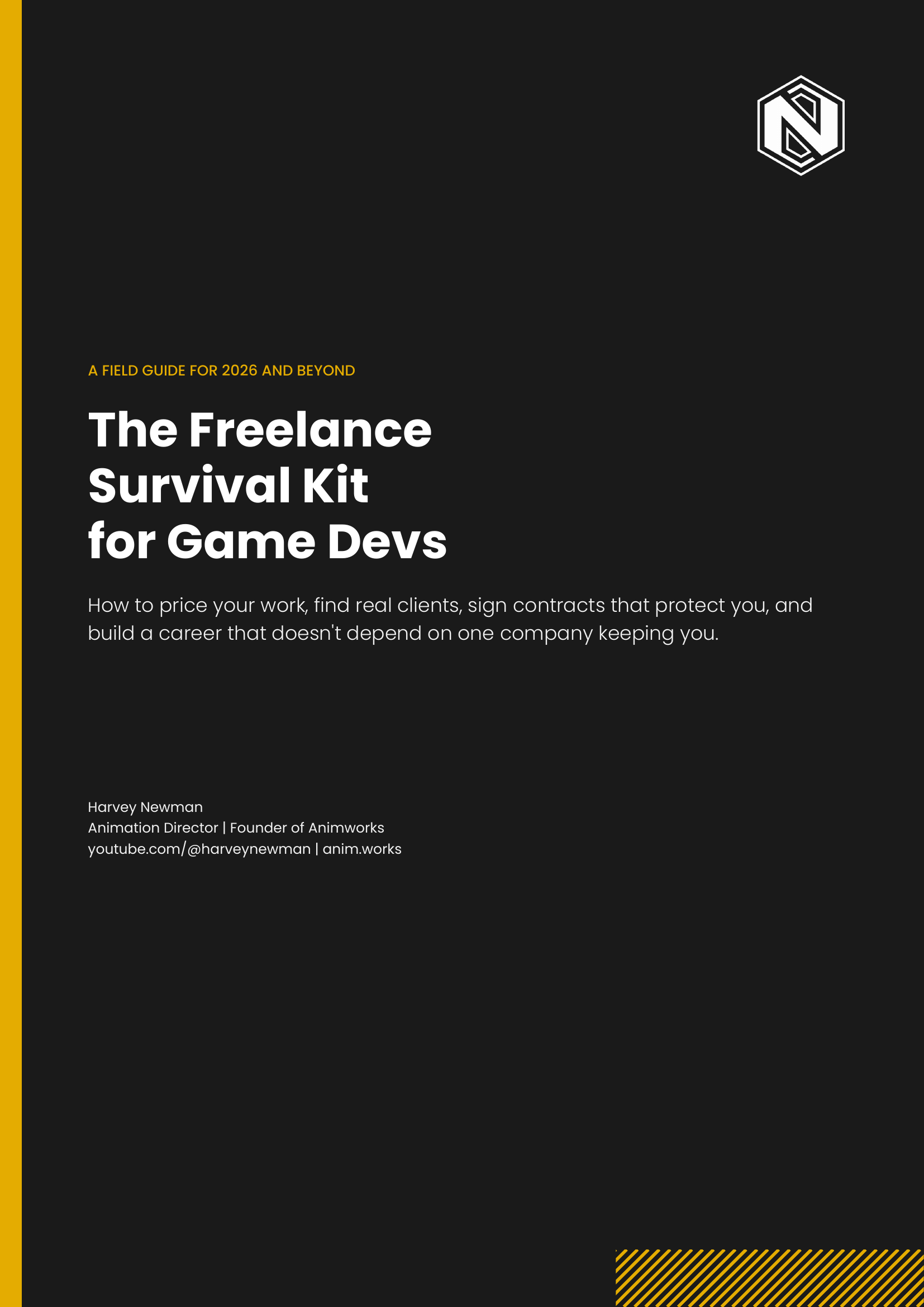 13 pages, PDF
Get the kit, free
Thirteen pages. Delivered to your inbox and downloadable straight away.
Where the work went
The work hasn’t disappeared. Studios still want the work. It has shifted. They have stopped hiring people to do it and started buying it as a service instead, from co-development studios and freelancers.
9,200
games jobs lost in 2025. We passed that by late July this year.
games jobs lost in 2025. We passed that by late July this year.
11.5%
of the North American games workforce, gone in four years, while the global number barely moved.
of the North American games workforce, gone in four years, while the global number barely moved.
1st
Keywords Studios is now the single biggest hirer in game art, ahead of Rodeo FX and EA SPORTS.
Keywords Studios is now the single biggest hirer in game art, ahead of Rodeo FX and EA SPORTS.
Figures from Amir Satvat’s layoff tracker and ArtBlast’s July 2026 game art jobs report.
Entry level took the worst brunt of it all. The outsourcers are having a hard time of it too, with cuts at Virtuos, Keywords and Sumo Digital in the last eighteen months. So the work moved, it changed shape, and the pool got smaller, all three at once. Which is why applying to two hundred postings and waiting is now the worst use of your week.
Start at your level
The advice that ruins careers is advice aimed at the wrong level. A senior telling a junior to hold out for their rate. A junior telling a senior to take whatever is going. So the guide gives each level its own page, and you print the one that is yours.
-
01
No paid credits yet
Manufacture proof. Three pieces that look like the job you want, not three that show range, and all three finished. An unfinished masterpiece is worth less than a finished good one.
There are free rigs here if you need something to animate with.
-
02
One to three years
Become reliable and specific. The freelancer who hits the date beats the more talented one who goes quiet, every time. Pick a lane, learn to scope, and use a written contract even for people you like.
-
03
Three to eight years
Turn the skill into a business. Most people stall here, because they keep freelancing like an employee. Raise the rate on new clients rather than current ones, move to a day rate, and write case studies instead of leaning on the reel.
-
04
Eight years or more
Sell the judgement. Your experience is the product now, so stop pricing it like production hours. Reviews, pipeline audits, direction days and mocap supervision sell at multiples of a production day.
What is in it
Thirteen pages, free, and built to be printed and written on. Here are six of them.
 Page 6
Your real day rate
Work out the number you should never quote below. You do not get 260 billable days in a year, you get about 180 once holiday, admin and the gaps between contracts come out, and the guide does that sum with you.
 Page 7
The eight clauses
Never start a job without these eight things agreed in writing. Also the red flags in a brief that mean walk away, and what to do on day one, seven, fourteen and thirty when an invoice goes past its date.
 Page 8
Six routes to work
The six ways work reaches you, ranked by how well each one pays off. Job boards come near the bottom, and the cold outreach message I send to studios is written out in full so you can copy it.
 Page 9
The AI question
Where AI saves a freelancer real time, where handing it the work costs you the client, and the one question to ask before you put anything covered by an NDA near it.
 Page 10
The first ninety days
Thirty tasks in the order to do them, whether you are starting from nothing or restarting after a redundancy. One tick a day is a good pace.
 Page 11
Keeping it running
The weekly, monthly and quarterly habits that keep the pipeline full, so the quiet months stop arriving as a surprise.
Watch the video
The kit is the companion to this week’s video, where I go through where the work went and what to do about it at each level.

The book
Want the long version?
The kit is thirteen pages. The book is the whole argument: getting in, staying in, and building something that survives the cycles this industry runs on, drawn from twenty years across AAA and indie studios.
Published by CRC Press. The first hundred copies here are hand signed and individually numbered, and you can put a name in the signature at checkout.