













Spine Jam
CURATED QUALITY
Every resource hand-picked by pros
COMMUNITY DRIVEN
Built by animators, for animators
Every resource hand-picked by pros
Built by animators, for animators
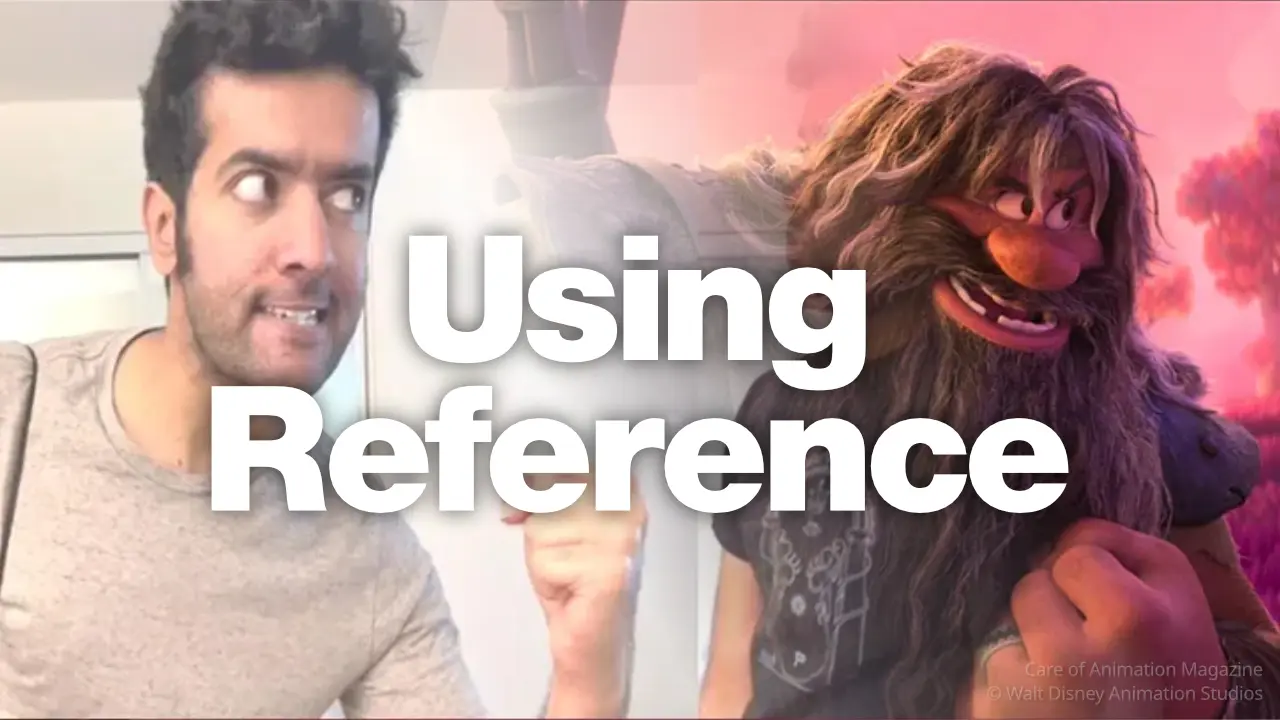
At some point someone probably told you to shoot reference. A mentor, an instructor, a tutorial, or a director. Good advice. But too much of a good thing can be detrimental. Relying on video footage (whether you shoot it yourself, or find reference) too much, can lead to motion that lacks energy. As a base to start from, video footage can make the animation process a lot faster, especially if you need help creatively, so it’s definitely not something to avoid. But finding a balance between what is useful and what needs something extra from you, the animator, can sometimes be difficult to find.
Here’s what reference does well, where it starts working against the animation, and how to stay on the right side of that line.
The human body is complicated. Even after years of studying movement, you’ll still miss things. The way weight shifts after a step lands. The micro-rotation in the shoulder before an arm swings. The slight lead in the head on a fast turn. Your brain fills in a lot of gaps when you’re watching someone move in real life, but those same gaps show up in your work when you try to animate from memory.
Reference slows all of that down. It lets you scrub through a moment frame by frame and really look at what’s happening. You catch timing you would have guessed wrong. You notice overlapping action you would have normally glossed over. You see the actual arc of that hand, not the arc you imagined it had.
Those nuances are extremely useful. Shooting reference, or pulling clips from film and video, is one of the most reliable ways to keep your work grounded in how movement actually works. It keeps things real.
The trouble starts when reference footage becomes the animation.
If you’re copying poses directly from your reference, matching your timing frame for frame, building keys that are traceable to specific frames in your video, you’re not really animating. You’re transcribing, rotoscoping. And the result usually looks like it.
Rotoscoped animation has a particular feeling to it. It’s hard to put your finger on at first, but once you know what you’re looking for you can’t unsee it. It tends to feel flat. It often lacks weight. The timing can be technically accurate to real life and still feel wrong in animation, because real life doesn’t read the same way pushed, stylized movement does.
Part of why is that real human movement is full of tiny corrections, wobbles, and micro-adjustments that our brains filter out when we’re watching someone in person. On screen, framed in a camera, those same movements can look unintentional. They read as noise instead of life.
Animation gets to cheat. It gets to take a genuine feeling and push it past what’s physically real to communicate it more clearly. A sad walk in real life might have a barely perceptible slump. But in animation, you can drop the shoulders, drag the feet, soften the neck, and slow down the whole tempo. The audience feels it more because the movement is speaking the same language as the emotion, just louder.
Copy reference too closely and you lose the exaggeration.
Think of reference as research, not instruction.
Before you block anything, watch your reference a few times straight through. Don’t scrub, don’t analyze, just watch it and let yourself react to the movement. What does it feel like? Heavy? Cautious? Loose? Guarded? Let that feeling be the thing you try to amplify, not the specific poses. The posing will come later. You want to “feel” the overall emotion or action, first.
When you go back and look more carefully, you’re looking for understanding. Why does this feel heavy? Why does the kick feel like it snaps so nicely? What’s making the fall feel so impactful? Now you’re pulling out principles. You’re building a picture of how this kind of movement works, and that picture is something you can apply, push, and adjust.
That’s a very different process from looking at frame 14 of your reference and asking where the wrist is.
As stated above, copying poses directly is something to avoid when looking at reference. But timing is a sneakier trap.
Reference footage can be shot at 24, 30, or 60 frames per second. Your animation might be running at a different frame rate. But more importantly, timing that works in live action almost always doesn’t hit the same way in animation. Real anticipation is usually very subtle in real life. Real follow-through fades gradually. In animation, you can compress those things, exaggerate them, time them differently, make them hit harder.
If you pull your timing directly from reference, you might be building in pacing that was designed for a real human body in a real space, not for a stylized, animated character whose entire feel is made up of creative choices. If your reference footage is shot at the same frame-rate as your animation, and you mirror exactly the posing and timing, your animation will feel sluggish. It’s missing the “animation” part of the animation.
Use reference to understand the general rhythm. Then trust yourself to find the timing that actually amplifies the animation. They might end up close, but chances are, they will be pretty different.
Here’s roughly how I approach it.
If you’re animating a shot in a cinematic or in a traditional series/feature film, try to match your camera angle to your shot as closely as possible. Act the beats out as close to the character as you can and, if it’s an action shot, try to perform the action to the best of your abilities (safely). It also helps to ask someone else who might be better-suited to the action to do the performance. Shoot multiple takes and, if you need, edit the parts of the best takes together.
After the shoot, watch the reference a few times, then write down a handful of impressions. Not specifics, just the character and feeling of the movement. Then go back and pick out two or three things that seem to be doing most of the communicative work. The thing that makes this feel like this. It could be posing, it could also be timing. Note those down.
When blocking starts, I look at the reference for the basic posing, but at the same time, I’m exaggerating the poses. I check the feel of the timing, and also seeing how I can adjust the pace. I’m trying to animate with the reference as a base, and making adjustments according to the feeling I wrote down earlier. When something isn’t working, I go back to the reference to check my logic. Sometimes it confirms I’m on track and I just need to make a few changes. Other times, it shows me I’ve drifted too far.
By the end of blocking I might have looked at my reference a dozen times, but none of those poses are exact copies, and almost always, the timing is drastically different. They’re merely informed by what I saw and reinterpreted for this character, this action, this performance.
The above is one approach, and certainly not the only. Some animators work much more closely with reference throughout, especially on productions where accuracy to specific motion is part of the brief. Many game studios use mocap that gets close to rotoscope territory in places, and there are real reasons for that depending on the context and timeline. However, even with mocap, similar adjustments can be made to posing and timing, if the production allows.
The underlying point is that awareness matters. Know what the reference is doing for you at each stage. Is it helping you understand movement? Check. Is it giving you something to push against? Also check. Is it starting to substitute for your own decision-making? That’s the thing to be wary of.
Reference is a tool for making your animation more true, not more literal. That distinction is easy to lose track of when you’re on a deadline and the reference is right there and your blocking is due in the morning. Keeping it in mind tends to make your work feel more alive.
If you’ve been animating for a while and you don’t regularly shoot reference, it might be something to try more consistently. On the flip, if you shoot reference all the time, but your work sometimes ends up feeling sluggish or flat, try keeping a bit more distance from it during blocking. The goal is always to serve the performance, and that means using every tool thoughtfully rather than leaning too hard on any one of them.
I’m interested to hear about other ways of using reference material. Let us know your thoughts in the comments!