













1st-Person vs 3rd-Person Animation

0
1st-Person_vs_3rd-Person

When people starting out in game animation ask which style they should focus on first, most seem to assume it doesn’t really matter. Animation is animation, right? You rig a skeleton, you keyframe it, you export it into the engine. The fundamentals are universal, the tools are interchangeable, and first-person versus third-person is just a camera setting someone else worries about.

Right?

In my experience, that assumption can cause some issues down the line.

I wouldn’t go so far as to say the two have nothing in common… that’s for sure an overstatement and plenty of animators move between them comfortably over a career. But they do pull you in genuinely different directions, in terms of what you’re trying to achieve, what the technical constraints are, your mindset when you set keys, and honestly, how you think about what the player is actually experiencing. Studios tend to know this, which is why job postings almost always have specialty roles for one or the other. It’s worth understanding why.

To get at that, you have to start, not with animation technique, but with perception.

What's the diff?


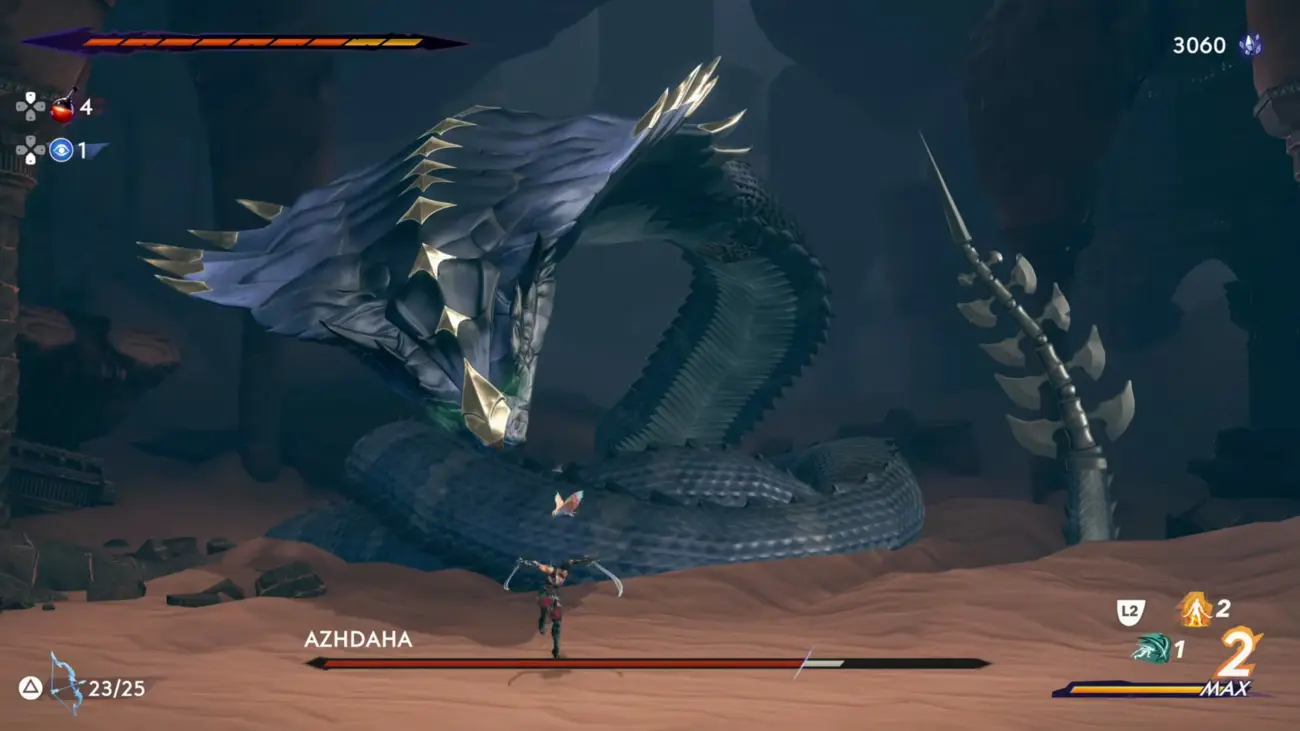
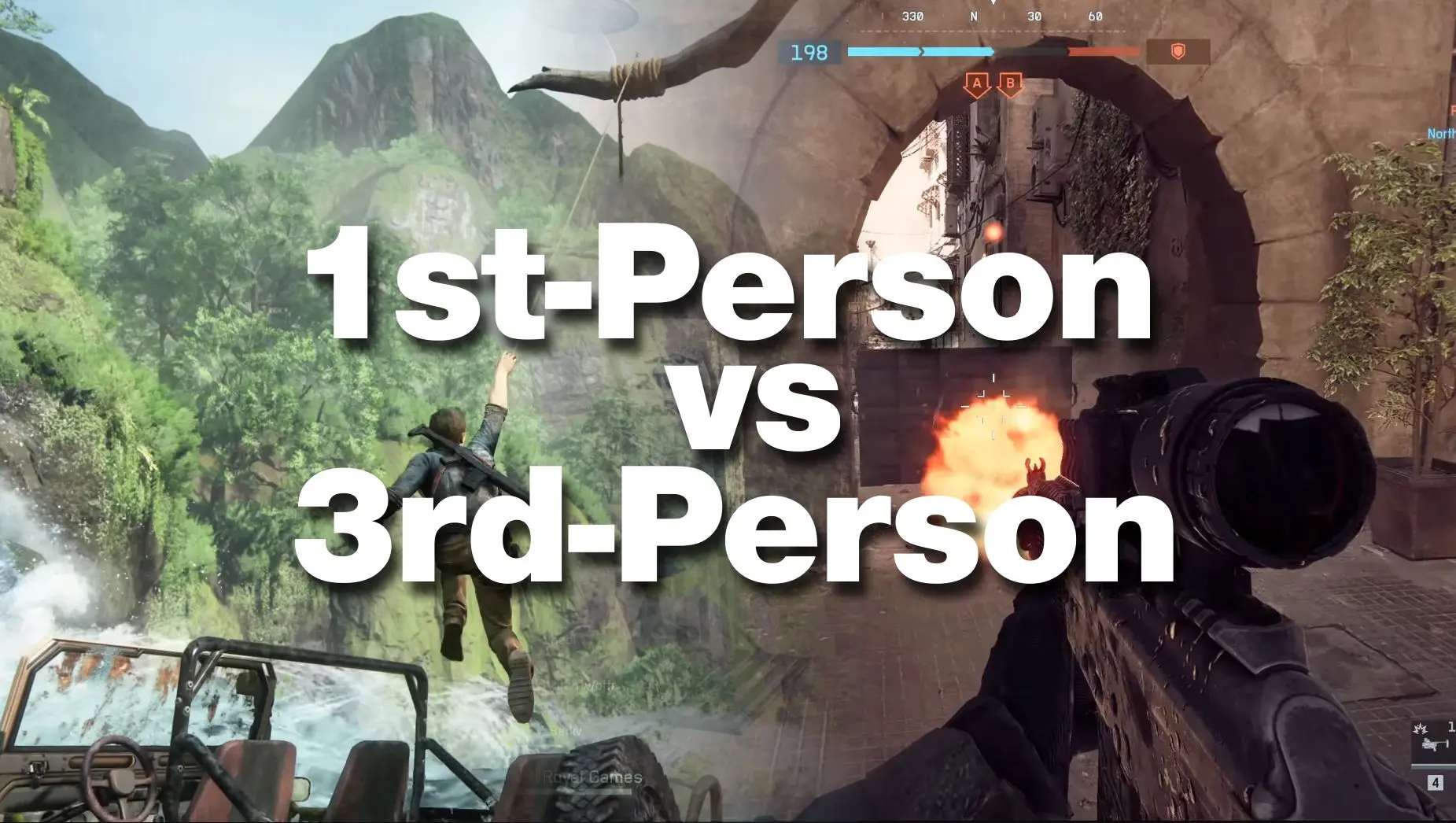
In a third-person game, the player watches a character. That character is an avatar, a stand-in for the player, but it exists at a distance. The camera typically sits behind or above the character and frames them within the world much like a film camera frames an actor. That distance matters a great deal for the animator, because everything you create will be read as full-body. They can pick up on a heroic landing pose, the sway of a cloak, the way a character shifts their weight before throwing a punch. The eye has room to roam across the whole figure.


In a first-person game, there is no full character to watch. There are the player’s arms /hands, a weapon, and the world moving around them. The camera is not orbiting an avatar. It is meant to be the player’s eyes. And that is where things become quite different, and in some ways, considerably harder. You are not animating a performance. You are trying to communicate a sensation.

Third-person: thinking in silhouettes

Third-person animation draws heavily from classical animation and live-action performance. The foundational principles, things like anticipation (to a point), follow-through, squash and stretch, secondary motion, all apply here. A good third-person animator thinks constantly about silhouette, because players read a character’s state primarily through their outline. Is this character relaxed or on edge? Is this creature heavy or quick? Is an attack coming? All of that information travels through posture, through the arc of a swing, through the “tell” of an enemy’s antic pose.


You also have a luxury that first-person work rarely grants: the player can see the whole body at once. That means you can create a pose the way a sculptor works on a figure. Weight lives in the relationship between the hips, feet, and ground. Intention shows in the body’s line-of-action. Personality can come through a hundred small secondary details that reward a player who pays attention.

THIRD-PERSON PRIORITIES

FIRST-PERSON PRIORITIES

Clear, full-body sillhouette

Precise FOV, screen-space framing

Full-body weight feel

Weight shown through arms, camera

Instant input response

Instant input response

Character personality, full-body

Personality through arms, hands, camera

Action readability from multiple camera angles

Action readability from 1st-person camera

Complex locomotion blend tree

Simpler loco tree

The above comparison is by no means exhaustive, but it gives an idea of some similarities and differences in freedoms, obstacles, and limitations of each animation type.

Diving a bit into the differences in locomotion systems, third-person involves more complex locomotion work than one might expect. A character moving through the world needs to transition fluidly between idle, walk, jog, sprint, strafe, crouch, and more, blending between states in ways that feel natural no matter which direction the player is moving or how hard they’re pushing the stick. The animator isn’t just making individual clips. They’re building libraries of motion that the engine blends together at runtime, thinking carefully about foot planting, root motion, and sometimes how the character handles uneven ground. That systems-level thinking is central to the third-person loco.


First-person, on the other hand, doesn’t need to worry about foot-slipping or contacts. Rather, the focus is on whether the visible parts of the player’s body (typically arms, hands, weapon) feel right for the speed of the given loco, feels right for the weight of the weapon being wielded.

First-person: the invisible body problem


First-person animation presents a pretty different set of challenges. The player can’t see most of their avatar’s body. There’s no full silhouette to read, no pose to admire, often no face at all. What they do see is whatever sits in the lower portion of the screen, usually a pair of hands and a weapon, and the world responding to their inputs around them.


This is sometimes known as the “invisible body problem”. You’re working on a character who is, for most purposes, not visible, and you have to communicate physical presence entirely through indirect means. The slight bounce of a gun barrel as the player walks. The subtle sway when they come to a stop. A small camera dutch when they lean around a corner. The way the arm poses changes when the character crouches. None of these are body movements in any traditional sense, but they are the main vocabulary through which first-person animation conveys the feeling of actually inhabiting a body, what we noted earlier as the “feeling” or “sensation”.


The effect this has on technique is considerable. In third-person work, exaggeration is often your friend. A slight overshoot, a big anticipation, a dramatic follow-through arc can make a move feel punchy and alive. In first-person, push those same instincts too far and you’ll make people feel unwell. The camera is the player’s head, and if it bounces aggressively or rolls too much or the field of view warps during a sprint, a meaningful chunk of your audience is going to have a rough time. First-person animators learn to produce a sense of weight and impact through motion that is almost subliminal, things the player feels without consciously registering.


It changes how you evaluate your own work. The question morphs from “does this look good?” to “does this feel right?” and those turn out to be quite different things to consider.

Another thing to be aware of in first-person animations is the character’s shadow: will shadow-casting be done on the character being animated? Or will there be another, simplified mesh handling the shadows?

This is a very important question, as it can dictate how you set your first keypose.

If shadows are being cast by a different rig/geometry, you can “break” the offscreen parts of your character when animating. Many times, to achieve particular poses in first-person, the character must be contorted (off-screen of course). From the camera view, everything looks fine. But from a viewport camera, the body can look quite unnatural. This is acceptable if another pass of animation will be done on the shadow-casting rig, but if the design of the game has just one set of player geometry, this could cause problems down the line. It would be worth confirming this with production (whether it’s your Lead, Director, or the TA team) what shadow-casting system they have in mind before setting your keyframes.

The latency question


There’s another area where the two disciplines pull apart fairly sharply, and it’s one of the more technically demanding aspects of first-person work: input latency.

In a third-person game, a small gap between the player’s input and the character’s response is usually fine, and sometimes actually desirable. A character mid-stride needs a moment to finish a step before pivoting. A swordsman mid-swing can’t simply stop on a dime. Animation takes time to play, and because the player is watching from a distance, a few frames of committed motion can feel natural rather than sluggish.

In a first-person game, that logic doesn’t hold up the same way. The player isn’t directing someone else. They are that someone, and any noticeable lag between their input and the world’s response starts to break the sense of embodiment pretty quickly. If you go from idle to aiming a weapon and the sights lag for a few too many frames before starting, the gun stops feeling like an extension of your hand. It becomes an object you’re operating from a slight distance, which is exactly the sensation first-person perspective is trying to avoid.

Because of this, first-person animators work closely with programmers and systems people to keep animation latency as low as possible. Reloads, aiming transitions, melee attacks, all of these need to be structured so that the most critical responsive moment, the one where the player’s input registers, happens as close to immediately as possible. The follow-through and recovery can happen after the fact. But that first response needs to feel instant. It’s a different way of thinking about timing than most third-person work requires. It may feel too “unrealistic” at first, but, again, it’s the feeling that matters more than realism.

Screen space and framing


Third-person animation generally doesn’t treat the screen frame as a hard creative constraint. The player typically handles the camera, and it’s the animator’s job to make the character read well from many angles, since the player might be rotating the view while an animation plays out.

First-person animation is closer to cinematography in this respect. Everything you create lives inside a fixed field of view, a fixed frame, and has to work within it consistently. A weapon reload that looks great in isolation might be frustrating in practice if it sweeps across the center of the screen at a moment when the player needs to see something. A melee attack might feel good in terms of motion but accidentally obscure important information on screen at exactly the wrong time.

A lot of first-person animators will tell you they spend more time iterating directly in-engine, playing through with the full interface active, than they might on a third-person project. You’re designing for the whole screen, not just the character in it, and that shapes how you compose your animation.


Can we do both?


Plenty of experienced generalists work across both, and many do so very well, especially at smaller studios where specialization isn’t always possible. The disciplines aren’t so alien to each other that crossing over is some enormous leap. But expertise in one area doesn’t automatically transfer to the other, and if you’ve spent years in one, the difficulties tend to show when you try the other.

Third-person specialists crossing into first-person work can sometimes produce animations that feel a little loose or exaggerated, like the physical weight isn’t quite landing the way it should, or the starts of motions feel a bit slow. First-person specialists doing third-person work can end up with motion that’s technically clean but reads as a bit flat… competent movement without a lot of personality in it. Neither issue is irreversible, just something that’s worth being aware of going in. But who knows, you could be an ace when transitioning to the other specialty!

And honestly, understanding both makes you better at each. First-person teaches you to think rigorously about felt sensation and player perception in ways that can subtly sharpen third-person performance work. Third-person gives you compositional instincts and a wider expressive vocabulary that can lift first-person work beyond just functional motion.

But it’s worth approaching each separately, knowing that you’re working within  fundamentally different animation realms. In third-person, you’re mostly asking: what do I want the player to see? In first-person: what do I want the player to feel? Of course, both need to have the same question posed, but the balance tips toward one or the other, depending on which you’re working on.

As with many things in life: the more you do something, the better you get at doing it, so it’s definitely possible to master both.

Leave a Reply

Your email address will not be published. Required fields are marked *