












The Subtle Art of Secondary Animation
There are moments in animation that audiences rarely notice consciously, yet we can really feel. A character stops running, but their ponytail swings forward one extra beat before settling. A cape billows just a half-second after its wearer lands, then comes to rest. A dog’s tail droops slowly as the character receiving bad news processes it. These moments last under a second. They are never the point of the scene. And they are absolutely essential to why great animation feels alive.
This is secondary animation: the motion of elements that follow, react to, and echo the primary movement of a character or object. Hair, cloth, tails, ears, loose accessories, fabric folds, beads on a bracelet. None of these drive the story. All of them serve it. It’s like the icing on a cake.
Understanding why secondary animation matters requires understanding something fundamental about how human perception works, and what separates animation that merely depicts movement from animation that communicates life.
The Physics We Never Consciously Notice
Human beings are extraordinarily sensitive to physical plausibility. We have spent our entire lives watching the world move, and our brains have developed a finely tuned sense for what motion looks like under the mechanics of mass, inertia, gravity, and momentum. We cannot always articulate what we are reading, but we notice instantly when something is wrong.
Secondary animation is largely the art of honoring these subconscious expectations.
Hair has weight. When a character whips their head around, the hair does not teleport to its new position, nor would it stay rigid. It lags behind the skull, stretches outward with the momentum of the turn, and then settles back with a few diminishing wave-motions. Cloth has even more complex behavior: it gathers, stretches, compresses, and flows according to the speed of the body beneath it and the resistance of the air around it.
When animators skip this layer of detail, or are unable to put the extra time to get it right, the result is characters who feel like mannequins. Everything moves together, in lockstep, as though the character were carved from a single rigid material. The primary animation might be technically correct, the poses strong, the timing solid, but something feels missing. The character looks performed rather than alive.
Secondary animation restores the physics that sells the illusion.
Supporting the Emotion
Here is where things get interesting: secondary animation is not only about physical accuracy. It is one of the most powerful emotional tools in an animator’s kit.
Consider the tail. A tail on an animal character is pure emotional telegraph. The speed of a wag, the height it is carried, whether it curls under or sweeps outward, all of these communicate internal states that would take several lines of dialogue to convey otherwise. Skilled animators treat the tail as a secondary emotional instrument, tuning it to amplify whatever the primary performance is doing.
The same principle applies to hair and cloth, though more subtly. A character moving with confidence has hair and clothing that flows cleanly and settles quickly. A character who is frightened or defeated moves differently, and their secondary elements reflect it: fabric dragging, hair lank and slow, movement that lacks the crisp intention of a confident stride. The secondary elements are, in a sense, echoing the emotional weight of the moment.
Environment and tone of the scene can also be boosted with thoughtful secondary animation. If a character is in a tense final battle, atop a mountain, facing their enemy, hair, cloth, ribbons could be animated with vigor to show gusting winds which would further the tension, the feeling of danger.
This is why secondary animation is sometimes described as the difference between a character and a performance. Primary animation gives you what a character does. Secondary animation adds depth, texture, and lifts the emotion of the scene.
Overlap, Follow-through and Why Timing Is Everything
One of the foundational principles of classical animation, established by Disney’s Nine Old Men, is “follow through and overlapping action.” Secondary animation lives almost entirely within this principle.
Overlap refers to the way different parts of a character do not all move perfectly sync’d. The torso leads, the arms follow, the hair follows the head, the end of the hair follows the rest of the hair. Each element has its own momentum, its own relationship to the forces acting on it, and therefore its own timing.
Follow-through describes what happens after the primary action ends. The character stops, but the secondary elements continue moving, decelerating, and settling. How long this takes, and what path these elements take to reach rest, tells the audience an enormous amount about the weight, speed, and mechanics of the preceding action.
Get this timing wrong and the whole sequence falls apart. If hair settles too quickly, the it feels too heavy. If it settles too slowly or with too much wave motion, it could read as comedic, regardless of the intended tone. The animator has to develop an intuitive sense for how long is right for the weight, and mood being communicated, and then execute it with precision.
Overlap and follow-through can be roughly encompassed within the animation principle of wave-action, which most 2D animators understand well. It’s a technique that all animators should learn, even 3D animators. It’s easy enough to offset joints/controllers to achieve what seems like wave-action. But if the real concept of wave-action is applied, animators have much more control over the timing, the shape, the feel of the secondary motion.
This is one of the reasons secondary animation is genuinely difficult work, and could even be regarded as a specialty in itself. It requires both technical understanding and artistic judgment, and those two things have to work together, often frame by frame.
What Happens When It Doesn’t Quite Hit
It is worth looking at instances when it doesn’t hit the mark. Early 3D animation, particularly in the 1990s and early 2000s, frequently struggled with secondary animation. The tools existed to simulate cloth and hair, but they were computationally expensive and technically difficult to control. The result was a wave of animated shows and games where characters moved with excellent primary animation but stiff, glued-down secondary elements.
The uncanny valley is typically discussed in reference to facial realism, but secondary animation failures contribute significantly to it, too. A face can be photorealistic while the hair above it moves like a plastic helmet, and the combination produces a profound wrongness that audiences register viscerally even when they cannot name it. On the flip, if the secondary animation is overly-exaggerated, it can really stand-out, making the character/scene feel fake, taking the audience or player out of the scene.
This is why, as touched-on earlier, it’s important for all animators to understand the core theories of secondary animation. Once you learn it, put it into practice, and get better at it, your animations will really shine. Leaving secondary animation to basically be done by the software (be it through pure simulation, or offsetting controllers) is a missed chance to amplify your scene.
This is why many studios treat secondary animation not as a simulation problem to be solved, but as an animation problem to be crafted. There are many tools available that help with the secondary animation stage. A hybrid workflow of keyframe animation with a simulation on top of the main motion allows the animator to easily “art-direct” a simulation, pushing it further than a purely vanilla sim could.
The Craft, in Practice
Professional animators developing secondary animation typically work from a clear understanding of the primary performance first. What is the character doing? What is the emotional intention? What is the weight and speed of the primary motion? Only with those answers in hand does the secondary work begin.
The process involves making deliberate choices about how much lag to build in, how much wave, how quickly elements settle, and whether the secondary motion should amplify or contrast with the primary action. These choices are not made by physics alone. They are made by animators who understand that every frame is a communication with an audience, and that even the movement of a ponytail is part of the speech.
In studios working with simulation tools, there is often a dedicated pass where technical directors run cloth and hair simulations, followed by an animation pass where artists adjust, override, and finesse the simulation output to serve the scene’s needs. The simulation provides physical plausibility. The artist provides intention.
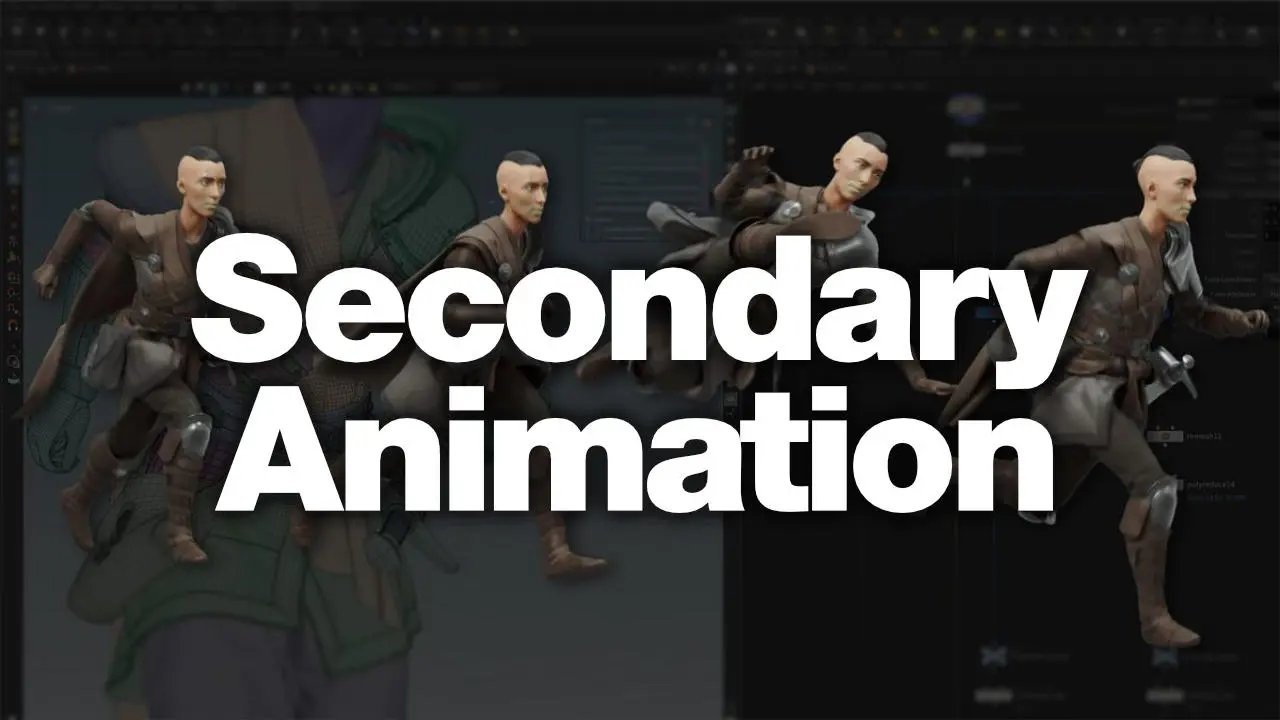
In other studios (and my personal workflow), a simple overlap plugin is used. But before the overlap simulation is run, an initial pass to keyframe the first controller of, say, a hair chain, would be done. I would feel the overall performance, then decide where I want exaggerated drag, how I want the hair to settle. I keyframe rotations on the first controller to build-in these artistic points. At this stage, the hair moves very stiffly, as I’m keyframing just the first controller. From there, I run the simulation on the controllers below the first ones, so that the rest of the chain follows the character, as well as my keyframed rotations. This is a best-of-both-worlds workflow and requires no dedicated simulation team — the results are mine alone (with the big help of the overlap plugin, of course).
Why It Matters More Than You May Think
Secondary animation is invisible when it works. That is its nature. The goal is not for the audience to notice how beautifully the cape moves. The goal is for the audience to feel the weight of the character wearing it, to believe in the world they inhabit, to be emotionally connected to the scene. Earlier, I made the analogy of secondary animation being the “icing on the cake”. Sure, the astute cake afficionados may mention that the icing is especially delicious, but most of us would take a bite and think “wow, this cake tastes great!” If that’s the reaction you get for your entire animation (primary, facial, secondary, etc.), job done.
That invisibility is not a limitation. It is the whole point. Great secondary animation is a form of craft that functions best when it goes entirely unnoticed, which means that the only true measure of its success is the degree to which audiences believe in something that does not exist.
The hair, the cloth, the tail: none of them tell the story. But they are a significant part of why the story is believed.